The 80s — mud, then colour
Most printing starts with colour. Bagru starts with mud. The Chhipa families in this village, thirty kilometres west of Jaipur, have worked the same sequence for three hundred years, and the first thing their blocks lay down is dabu — a paste of black clay, gum, powdered lime and wheat chaff, mixed by hand to the thickness that will hold an edge.
The printed cloth is dusted with sawdust so the wet resist cannot smudge, then dried hard in the sun. Only then does it go into the vat. The grey this drop is named for is kashish, drawn from rusted iron left to ferment with jaggery — a colour grown rather than mixed. The dye takes everywhere the mud is not. When the dried resist is beaten and washed away, what is left behind is the print: the part the dye never reached.
The ground underneath it is harda — myrobalan — which is why no Bagru print sits on true white. It sits on cream, slightly uneven, the colour of the fruit it was steeped in. Mr. Raj, who made the colour for this cloth, has spent twenty-five years on the part of the craft nobody photographs: which earth, which iron, how long to let it sit.
And then the 80s. The silhouette is borrowed wholesale from that decade — the long pointed collar, the boxy body, the snap buttons, the patch pocket sitting high on the chest. What makes it ours is where the contrast falls: the yoke, the placket, the pocket and the cuff are printed in syahi-begar, the paired black and beige that comes out of the same two vats as the grey. On an 80s shirt those panels would have been a second fabric. Here they are a second recipe, printed on the same cloth by the same hands.
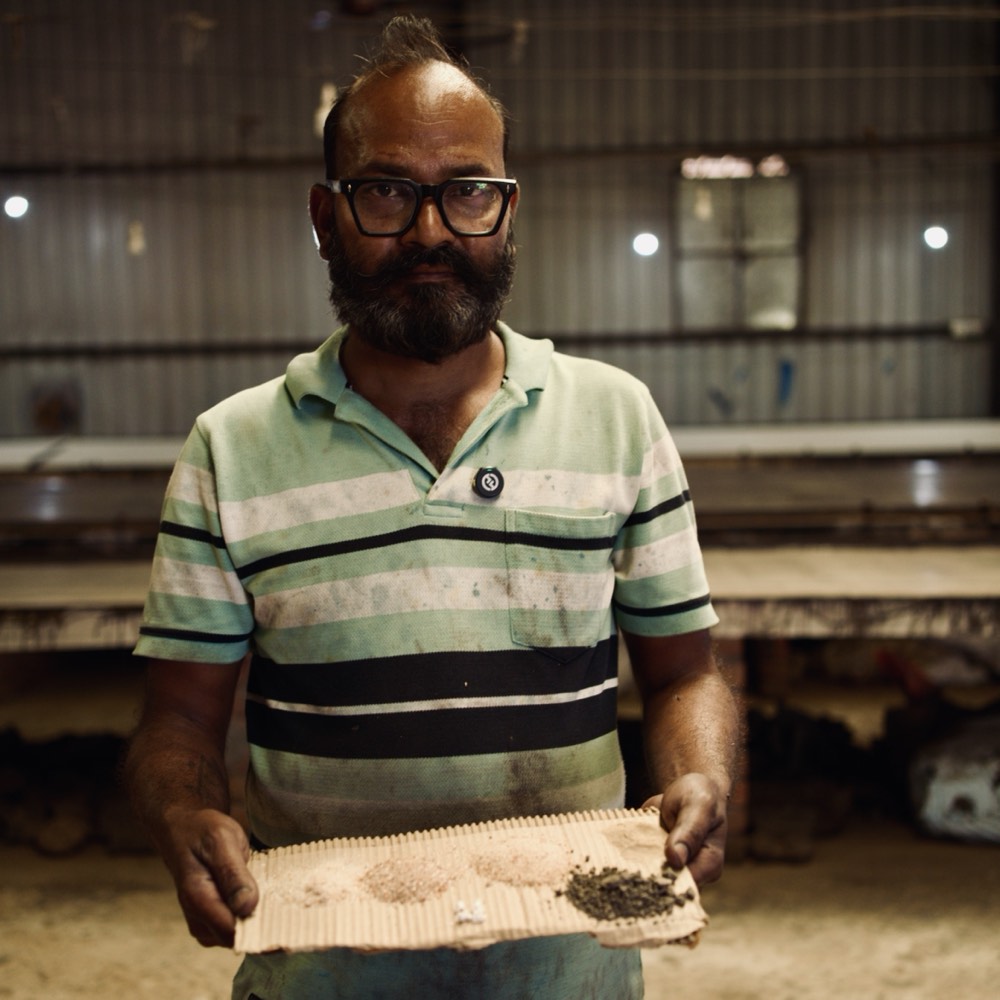
Twenty-five years at the printing table in Bagru. Mr. Raj's specialism is the part of the craft most people never see — the making of the colour itself: which earth, which iron, how long to let it ferment, how a dye behaves on a given day. He works in dabu, the mud resist, and in syahi-begar, the paired black and beige that gives this Shurta its panels. The kashish grey on this cloth is his.